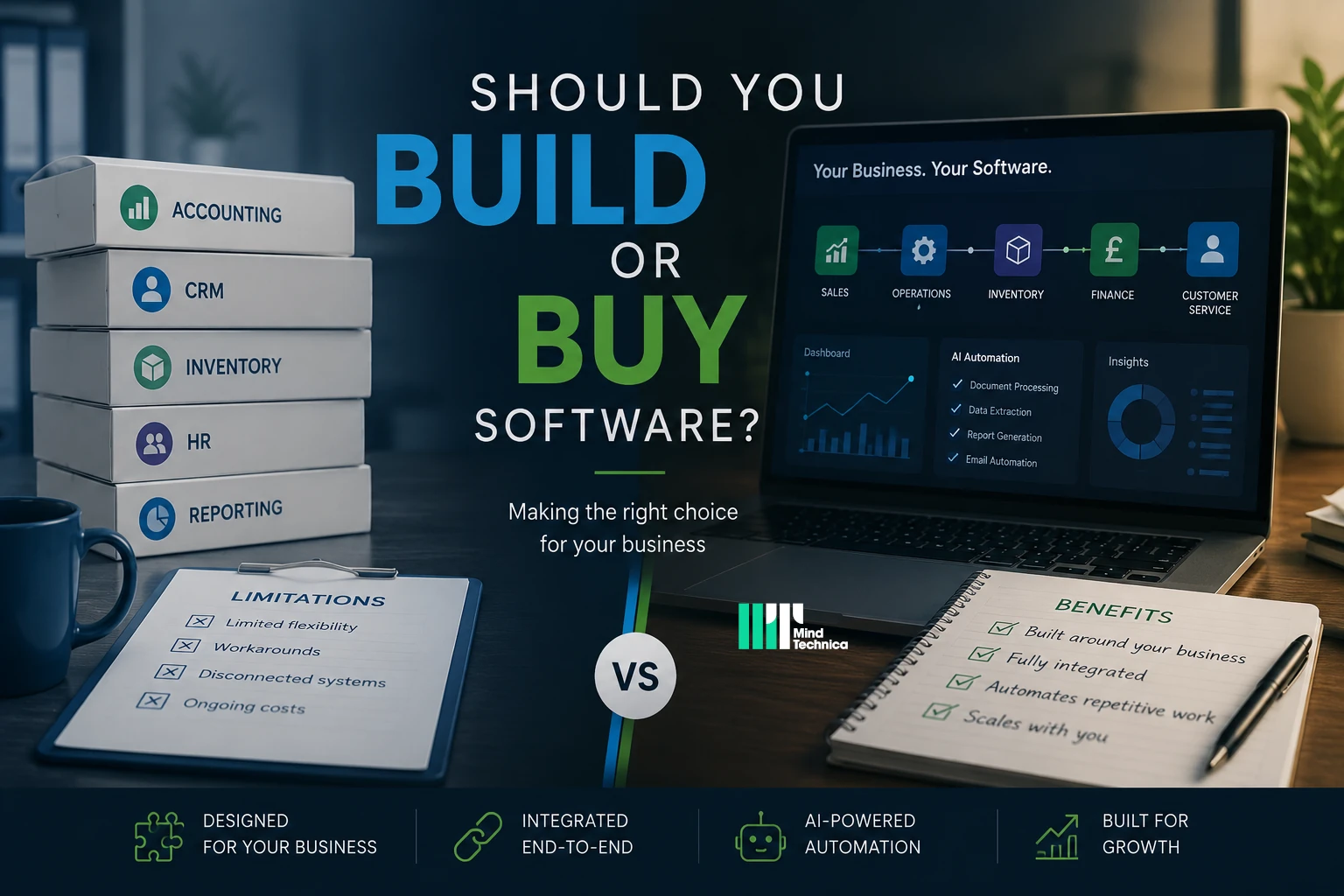
Every growing business reaches a point where its software starts to become a source of frustration rather than a competitive advantage. What once felt like the perfect solution slowly turns into a collection of workarounds, spreadsheets, disconnected systems, and manual processes that consume more time than anyone expected. It is usually at this stage that business owners begin asking an important question: should we continue adapting to existing software, or is it time to build something of our own?
There is no universal answer because every business is different. The right decision depends on the complexity of your operations, the uniqueness of your processes, your budget, and where you expect the business to be in a few years' time.
Off-the-shelf software exists for a good reason. It is quick to implement, relatively inexpensive to get started with, and often provides a wide range of features straight out of the box. However, because it is designed for thousands of different businesses, it inevitably makes compromises. Every organisation has its own processes, priorities, and ways of working, yet generic software often expects those businesses to adapt to fit predefined workflows. Over time, this leads to workarounds, duplicate data, and manual tasks that gradually become part of everyday operations.
Bespoke software takes the opposite approach. Instead of forcing your team to work around the limitations of the software, the software is built around the way your business already operates. It can connect every part of the organisation, integrating systems both vertically and horizontally so that information flows seamlessly between departments and management, creating a single source of truth instead of disconnected applications. This integrated foundation also makes it much easier to take advantage of modern AI. Rather than introducing another standalone tool, AI can be embedded directly into your workflows to process documents, generate quotations, extract information from emails, move data between systems, and automate countless repetitive administrative tasks. The result is not simply custom software, but a platform that evolves alongside your business while allowing your team to spend more time on work that genuinely creates value.
The challenge appears when your business begins adapting itself to fit the software instead of the software supporting the business.
Many companies gradually introduce manual workarounds because the system they purchased cannot quite do what they need. Staff begin copying information between applications, maintaining additional spreadsheets, or performing repetitive administrative tasks simply because different systems cannot communicate with each other. None of these activities individually seem significant, but together they consume hundreds of hours each year while increasing the risk of human error.
This is often the hidden cost of buying software. The licence fee may be affordable, but the operational inefficiencies created by forcing unique processes into generic software can become surprisingly expensive over time.
Cost is naturally one of the biggest considerations when comparing the two options. Buying software almost always requires a lower upfront investment, which explains why it is often the default choice. However, monthly subscription costs accumulate over many years, particularly when several different systems are involved. As businesses grow, additional users, premium features, and integration costs can significantly increase ongoing expenditure.
Custom software generally requires a larger initial investment, but it does not necessarily become more expensive in the long run. If a bespoke solution eliminates thousands of hours of manual work, reduces errors, improves customer service, and removes the need for multiple software subscriptions, the return on investment can quickly outweigh the development cost.
Another important consideration is flexibility.
Businesses evolve constantly. New services are introduced, departments expand, regulations change, and customer expectations continue to rise. Off-the-shelf software develops according to the priorities of its vendor, not the individual needs of your business. If a feature you require is not on their roadmap, there is often little you can do except wait or find another workaround.
With bespoke software, the roadmap belongs to you. New features can be added as the business grows, existing workflows can be refined, and the system can adapt alongside your organisation rather than holding it back.
This flexibility becomes particularly valuable for companies that have developed specialist processes or competitive advantages that cannot easily be replicated using standard software.
That said, bespoke software is not always the right decision.
If your requirements are relatively simple and align closely with widely available products, building a custom solution is unlikely to deliver enough value to justify the investment. There is little benefit in recreating software that already performs your requirements effectively. Successful software projects begin by identifying genuine business problems, not by assuming that custom development is automatically superior.
The most effective technology strategies are rarely based on replacing everything. Instead, they combine reliable commercial software with carefully designed custom solutions where they create the greatest impact. Standard platforms continue handling common business functions, while bespoke applications automate the unique processes that differentiate the business from its competitors.
This approach allows organisations to benefit from the reliability of established software while gaining the flexibility and efficiency that only custom development can provide.
Ultimately, the decision is not simply about whether to build or buy software. It is about understanding where your business creates value and ensuring that technology supports that value rather than restricting it.
If your team spends its days performing repetitive administrative work, copying data between systems, searching through documents, or working around software limitations, the problem may not be your staff or your processes. It may simply be that the software was never designed for the way your business operates.
Choosing the right technology is less about following trends and more about making thoughtful investments that remove friction, improve productivity, and create room for future growth. Whether that means purchasing an existing platform, developing a bespoke solution, or combining both approaches, the best choice is the one that allows your business to work more effectively today while remaining adaptable for tomorrow.
If you are weighing up whether to build or buy, get in touch for a free consultation. We help organisations identify where custom software creates real value and where off-the-shelf tools are the smarter choice.